Best Adaptogens for Stress relief- How Ashwagandha, Rhodiola, Reishi & Ginseng Work Together
Stress is everywhere these days. You wake up tired, power through the afternoon on caffeine, and still can’t wind down at night. If that sounds familiar, you’re not alone — and you’ve probably heard the word “adaptogen” come up more and more in wellness conversations.
But what exactly are adaptogens? And do they actually work?
This guide breaks it all down — the science, the herbs, how they interact with your body, and why some people are switching from capsules to liquid supplements for faster results.
What Are Adaptogens and Why Are They Getting So Popular?
Adaptogens are natural plant compounds that help your body handle stress more efficiently. Think of them as a kind of internal shock absorber — they don’t sedate you or artificially boost you. Instead, they help regulate your stress response system so it fires at the right level, not too high, not too low.
The term was coined by Soviet scientist Nikolai Lazarev in the 1940s while researching ways to improve performance under extreme conditions. But the herbs themselves have been used in Ayurvedic and Traditional Chinese Medicine for thousands of years.
What’s driving today’s renewed interest? A few things: rising rates of chronic stress and burnout, growing distrust in synthetic pharmaceuticals, and better clinical research confirming that some of these herbs genuinely work.
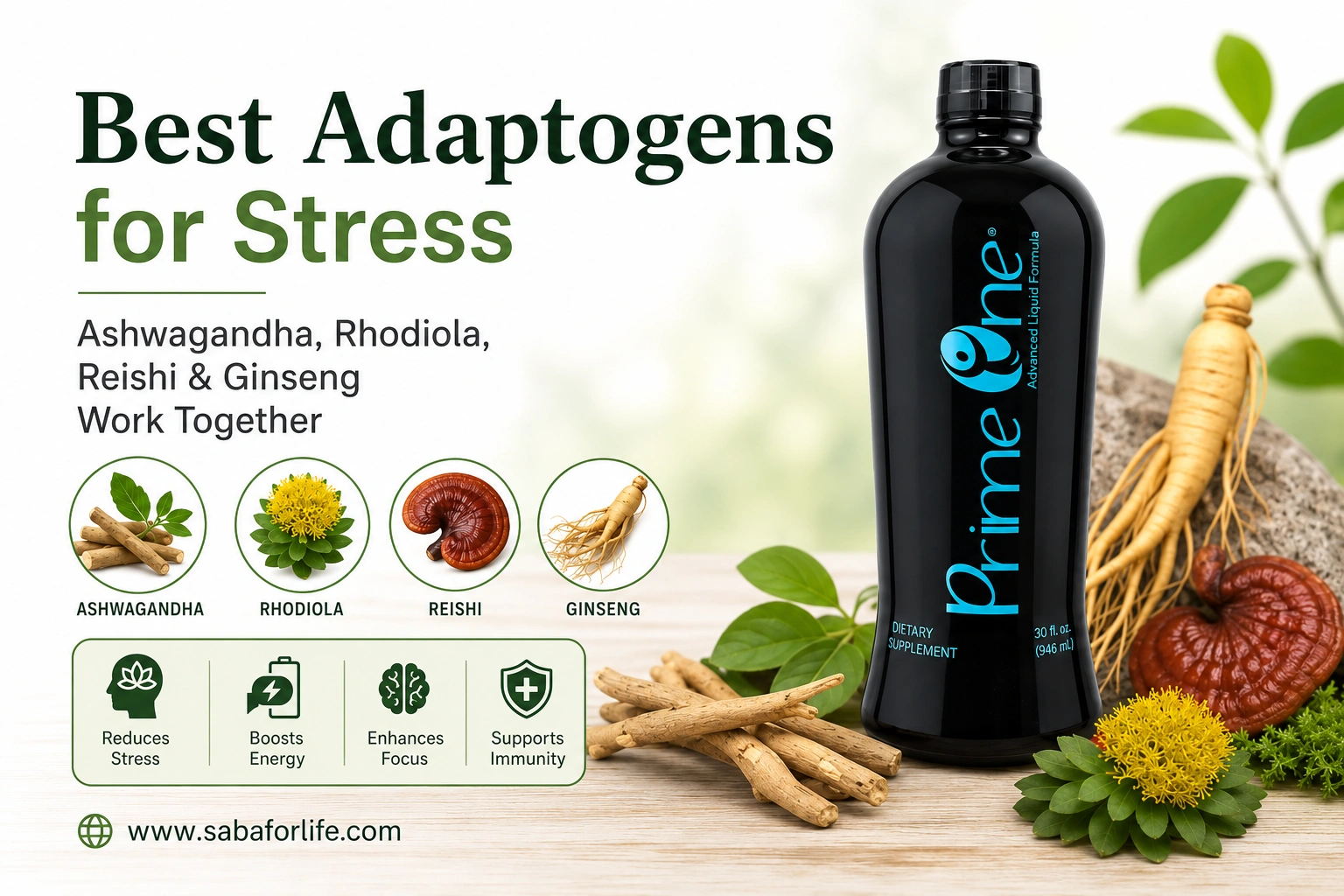
The 4 Adaptogens That Actually Move the Needle
Not every plant called an “adaptogen” has strong evidence behind it. These four, however, have both a track record and actual research to back them up.
1. Ashwagandha — The Cortisol Controller
Ashwagandha (Withania somnifera) is probably the most studied adaptogen in Western clinical research right now. It’s been a pillar of Ayurvedic medicine for over 3,000 years, where it’s known as a “Rasayana” — a class of herbs used to rejuvenate the body and promote longevity.
What it does-
- Lowers cortisol levels (the primary stress hormone)
- Supports the HPA axis — the stress response system in your brain and adrenal glands
- Reduces perceived anxiety and stress in clinical trials
- Improves sleep quality, especially time to fall asleep
- May support testosterone and physical performance in men
What the research shows- Multiple controlled trials have found that daily ashwagandha supplementation can reduce cortisol by 20–30% compared to placebo. A widely cited 2019 study showed significant improvements in sleep quality and morning alertness among participants who took KSM-66 ashwagandha extract for 10 weeks.
If you feel wired at night but exhausted in the morning, if small things send your anxiety spiking, or if your energy has been consistently flat — ashwagandha is typically the first adaptogen worth trying.
2. Rhodiola Rosea — The Mental Fatigue Fighter
Rhodiola is a root that grows in cold, mountainous regions of Europe and Asia. It’s been used in Russia and Scandinavia for centuries to help people endure harsh physical and mental conditions — Viking warriors, Siberian villagers, high-altitude workers.
It works through a different mechanism than ashwagandha. Rather than primarily targeting cortisol, Rhodiola influences neurotransmitters like serotonin, dopamine, and norepinephrine. It also contains compounds called rosavins and salidrosides that protect neurons from oxidative damage under stress.
What it does-
- Reduces mental fatigue quickly — some studies show effects within hours
- Improves focus and cognitive accuracy under pressure
- Reduces burnout symptoms in stressed adults
- Supports physical endurance
Where it shines- Rhodiola tends to work best for acute, in-the-moment stress — a big presentation, a sleepless period, a demanding work sprint. People often report that it takes the “edge” off mental strain without making them feel drowsy.
Combined with ashwagandha, you get both short-term mental clarity and long-term cortisol regulation — a combination that addresses different aspects of the same problem.
3. Reishi Mushroom — The Immune-Nervous System Bridge
Reishi (Ganoderma lucidum) has a different profile from the two above. Often called the “mushroom of immortality” in Traditional Chinese Medicine, it’s valued less for quick energy and more for deep, systemic calm — the kind that improves over weeks of consistent use.
Reishi contains two key classes of active compounds: triterpenes (which have anti-inflammatory and cortisol-modulating effects) and beta-glucans (which support immune function). This dual action is why reishi sits at the intersection of stress and immunity — because chronic stress is one of the biggest suppressors of immune function.
What it does-
- Calms the nervous system, particularly the parasympathetic “rest and digest” branch
- Reduces inflammation linked to chronic stress
- Supports immune resilience
- Improves sleep depth and recovery quality
Who it’s for- Reishi is especially relevant if your stress is showing up physically — you’re getting sick frequently, your recovery from exercise is slow, or you just feel chronically run-down. It’s a slower-acting herb, but its effects tend to be more foundational.
4. Ginseng — The Energy and Resilience Driver
Ginseng (Panax ginseng) might be the most globally recognized adaptogen. Used in Chinese and Korean medicine for thousands of years, it’s earned its reputation as an energy tonic — but its effects go deeper than just stimulation.
Ginseng’s active compounds, called ginsenosides, influence the hypothalamic-pituitary-adrenal (HPA) axis in ways that help regulate both the stress response and energy metabolism. Unlike caffeine, which forces cortisol up, ginseng helps your body produce energy more efficiently from the inside out.
What it does-
- Supports stamina and physical endurance
- Improves mental performance, especially under stress
- Stabilizes blood sugar — which directly affects mood and energy
- Supports healthy testosterone levels and libido
- May reduce adrenal gland stress markers
When to use it- Ginseng is often well-suited for people dealing with fatigue that has a physical component — whether from overtraining, poor sleep, or sustained demanding work. It’s also popular in formulas targeting men’s health, as the link between ginseng, cortisol regulation, and hormonal balance is increasingly supported by research.
Why Combining These Four Makes More Sense Than Taking One Alone
Here’s something most supplement marketing doesn’t explain clearly: these adaptogens work through different pathways. That’s exactly why stacking them makes biological sense.
Ashwagandha regulates cortisol at the hormonal level (HPA axis)
Rhodiola protects neurotransmitters and reduces mental fatigue (CNS level)
Reishi addresses inflammation and immune suppression (cellular level)
Ginseng supports energy metabolism and adrenal recovery (metabolic level)
When stress hits you, it doesn’t just hit one system. It cascades through your hormones, brain chemistry, immune function, and cellular energy all at once. A formula that addresses all four pathways is addressing what stress actually does to the body.
Liquid vs. Capsules- Does Delivery Form Really Matter?
This is a genuine debate in the supplement world, and the honest answer is: yes, it can make a significant difference depending on the herb.
Capsules require breakdown in the stomach before absorption begins. For some herbs, this is fine. For others — particularly those with large, complex molecules — it can slow absorption and reduce bioavailability.
Liquid supplements bypass the need for capsule breakdown entirely. The compounds enter the digestive tract in a state that’s closer to ready-to-absorb, which means:
Faster onset- Many liquid supplement users report noticing effects sooner, particularly with adaptogens like Rhodiola that have quicker mechanisms
Better absorption for complex formulas- When you’re combining multiple active compounds, a liquid matrix can help maintain their bioactivity
Easier dosing- Liquids allow more flexible and precise dosing compared to fixed-dose capsules
This is why liquid adaptogen formulas have become one of the fastest-growing formats in the supplement industry — not just a trend, but a functional advantage.
Who Benefits Most from Adaptogen Formulas?
People who report the most noticeable results from multi-adaptogen supplements tend to share certain patterns:
- Sustained work stress that doesn’t resolve with rest
- Feeling “tired but wired” — exhausted during the day, alert at night
- Mood that fluctuates more than it should
- Slow recovery from illness or physical exertion
- Cognitive fog, difficulty concentrating for sustained periods
- General sense of being “depleted” without obvious cause
If several of those resonate, a well-formulated adaptogen blend addresses the likely root causes — not just the symptoms.
Natural Stress Relief with Adaptogens- Final Takeaways
Adaptogens aren’t magic. They won’t eliminate stress from your life or replace sleep. But they represent one of the more thoroughly studied classes of natural compounds for helping the human body handle what modern life throws at it.
Ashwagandha, Rhodiola, Reishi, and Ginseng each bring something different to the table. Together, they cover more of the biological ground that stress disrupts. And in a liquid format, those compounds get to work faster.
If you’ve been looking for a natural, evidence-backed way to build resilience, balance mood, and sustain energy without crashes — these four herbs, taken daily in the right form, are a solid place to start.