
Why Metabolism Slows After 30 — And How to Actually Fix It
You’re eating the same things you’ve always eaten. Maybe even less than before. You’re moving more, sleeping okay-ish, trying to do all the right things.
And yet — the scale doesn’t budge. Or worse, it creeps up.
If this sounds familiar, you’re not imagining it. And it’s not a lack of discipline. Your metabolism genuinely works differently after 30, and most of the advice floating around on the internet completely misses why.
Let’s get into what’s actually happening — and more importantly, what you can do about it.
First, What Even Is Metabolism?
“Metabolism” gets thrown around like it’s one simple switch that’s either fast or slow. The reality is more layered than that.
Your metabolism is essentially everything your body does to turn food into energy — every heartbeat, every breath, every time your muscles move. The part most people are talking about when they say “metabolism” is your Resting Metabolic Rate (RMR) — the calories your body burns just to stay alive while you’re sitting still.
Here’s the thing: RMR accounts for roughly 60–70% of your total daily calorie burn. Exercise? That’s maybe 10–30%. Which means the biggest lever you have for burning calories isn’t the gym — it’s what’s happening in your body at rest.
And that number starts shifting in your 30s.
Why It Actually Slows Down After 30
There are a few things happening at once, and they compound each other.
You’re losing muscle. Starting around age 30, the average adult loses 3–8% of their muscle mass per decade without active resistance training. This matters a lot because muscle is metabolically expensive tissue — it burns calories even when you’re doing nothing. Fat doesn’t. Less muscle = lower RMR = fewer calories burned daily, even if everything else stays the same.
Hormones shift. For women, estrogen and progesterone begin fluctuating through the late 30s and 40s, which directly affects how and where the body stores fat — particularly around the midsection. For men, testosterone gradually declines, which is tied to both muscle maintenance and fat metabolism. These aren’t dramatic overnight changes, but over years they add up.
Cortisol tends to run higher. Life in your 30s and 40s typically means more responsibility — career pressure, family demands, financial stress. Chronic cortisol elevation doesn’t just make you feel burnt out; it actively signals the body to hold onto fat, especially visceral fat around the belly, as a survival mechanism. Stress isn’t a mindset problem. It has real metabolic consequences.
Thyroid function can subtly change. The thyroid is the master regulator of metabolic rate, and its function can start shifting — sometimes subclinically, meaning it won’t show on a standard blood test but you’ll feel it. Fatigue, weight gain, brain fog, and cold sensitivity are common signs that thyroid function could be a factor.
You’re probably less active than you think. Not from laziness — from life. A demanding job means more sitting. A busier schedule means fewer walks. Less spontaneous movement adds up to significantly fewer calories burned each day, even if your dedicated workouts stay consistent.
None of these are character flaws. They’re physiological shifts that happen to almost everyone. The goal is understanding them so you can work with your body instead of against it.
The Biggest Mistakes People Make When Metabolism Slows
This is where most people go wrong, and it makes things worse, not better.
Eating way less. It seems logical — metabolism slows, so eat less to compensate. But when you drop calories too low, your body reads this as famine and actively lowers your RMR further to conserve energy. You’re now burning fewer calories at rest than before, feeling tired, and still not losing weight. Studies confirm that eating below 1,000 calories per day significantly suppresses metabolic rate — sometimes for months after you stop.
Doing only cardio. Cardio burns calories during the session, but it doesn’t do much for your RMR. Worse, if you’re doing a lot of cardio without adequate protein intake, you can actually lose muscle — the very thing you need to keep your metabolism running well.
Cutting protein. Protein has the highest thermic effect of any macronutrient, meaning your body burns more calories just digesting it. It’s also essential for maintaining and rebuilding muscle. Most people cutting calories are also inadvertently cutting protein, which speeds up muscle loss and compounds the metabolic slowdown.
What Actually Moves the Needle
No hacks. No shortcuts. Just the things that consistently work when the research is looked at honestly.
Resistance training — non-negotiable. You don’t have to become a bodybuilder. Two to three full-body sessions per week with progressive resistance (meaning you gradually increase the challenge) is enough to maintain and rebuild muscle mass, which directly raises your RMR over time. This is the single most impactful thing you can do for long-term metabolic health after 30.
Protein at every meal. Target 25–35g of protein per meal. This supports muscle maintenance, increases the thermic effect of eating, and keeps you fuller for longer. Eggs, Greek yogurt, chicken, fish, legumes — the sources matter less than the consistency.
Sleep as a metabolic tool. One night of poor sleep measurably lowers your RMR the next day, raises ghrelin (hunger hormone), and blunts your body’s ability to burn fat efficiently. Chronic poor sleep is one of the most underestimated drivers of weight gain after 30. Seven to nine hours isn’t a luxury — it’s metabolic maintenance.
Managing cortisol seriously. Even 10 minutes of daily breathwork, a walk after dinner, or cutting your phone off an hour before bed can meaningfully reduce cortisol over time. Adaptogenic herbs like ashwagandha and rhodiola have also shown consistent results in clinical studies for supporting the body’s cortisol response.
Supporting thermogenesis naturally. Your body has a built-in process called thermogenesis — generating heat by burning calories. Certain compounds found in food and supplements support this: green tea catechins (EGCG), capsaicin from cayenne pepper, and caffeine at appropriate doses all have evidence behind them for modestly increasing calorie burn throughout the day, particularly when combined with activity.
A Note on Metabolism Booster Supplements — What to Look For
There’s a lot of noise in this space. Most products overpromise and underdeliver.
What the research actually supports in a metabolism support supplement: ingredients that assist thermogenesis without overloading your nervous system, compounds that help the body manage fat oxidation more efficiently, and formulas that support energy levels so you stay active — because movement is ultimately what compounds everything else.
A well-formulated metabolism support supplement works alongside your effort, not instead of it. If a product claims you’ll burn fat while sitting on the couch eating whatever you want — skip it.
SABA AM-300 — If You’re Looking for Supplemental Support
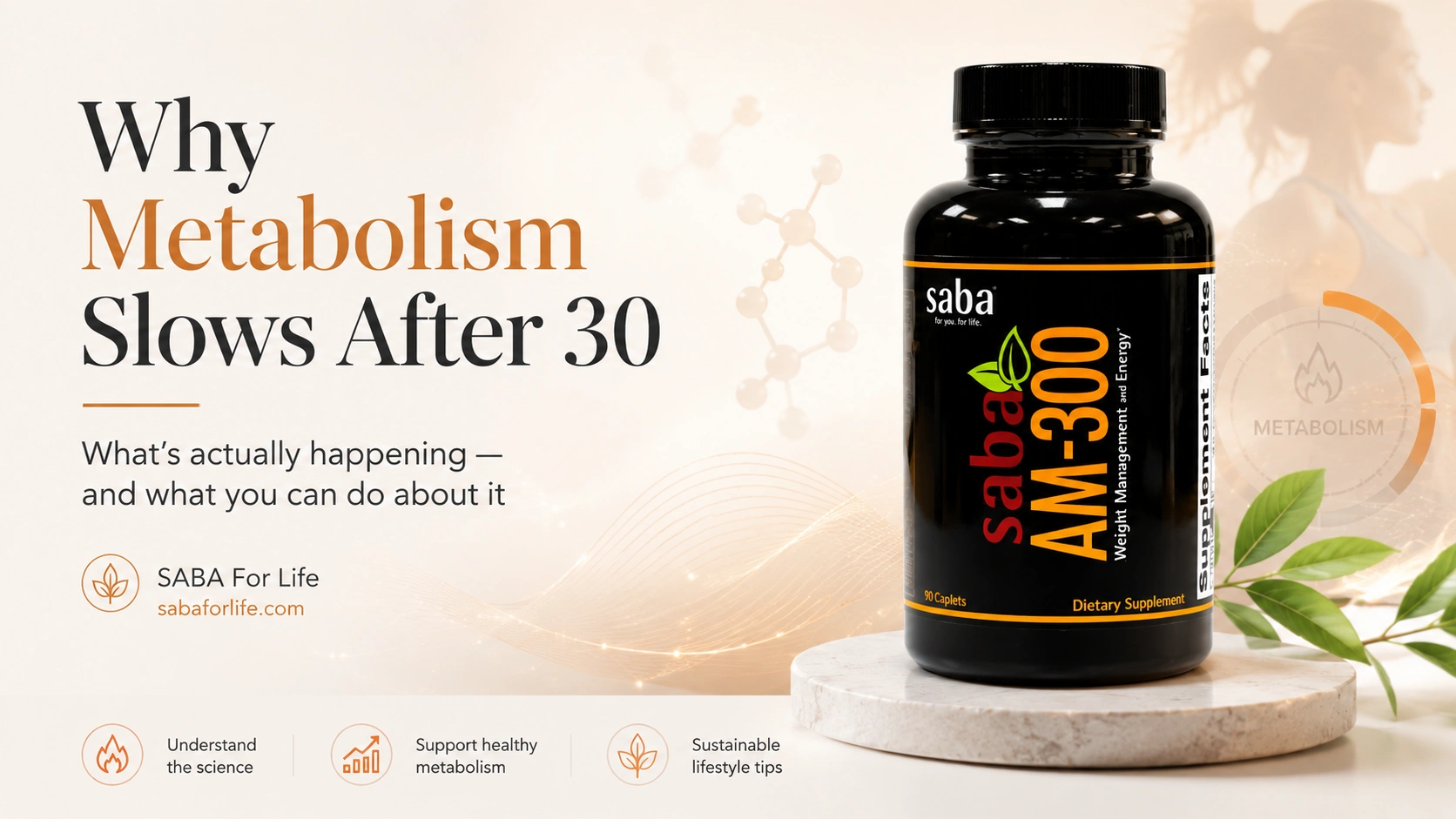
For those who want a supplement built around real metabolic support, SABA AM-300 is worth a look. It’s a 90-capsule (one-month supply) formula designed to support fat burning, maintain steady energy, and help manage appetite — the three areas where most people struggle when metabolism shifts.
It’s not a magic solution, but it’s designed to work with an active lifestyle — supporting the metabolic processes you’re already trying to improve through exercise and better eating habits. Clean ingredients, no drastic diet overhaul required, and a formula that’s meant to support your body’s natural fat-burning mechanisms rather than override them.
If you’re already doing the work and want added support, it’s a solid addition to a consistent routine.
How to Speed Up Metabolism Naturally After 30
A slower metabolism after 30 isn’t a verdict. It’s a signal that your approach needs to evolve.
More muscle mass, adequate protein, quality sleep, managed stress, and smart supplementation — these aren’t separate strategies. They work together as a system. Fix one and the others become easier. Let all of them slide and the slowdown compounds.
The people who navigate this well aren’t doing anything superhuman. They’ve just stopped fighting their biology and started working with it.
This content is for general wellness and informational purposes only. It is not a substitute for personalized medical advice. Consult a qualified healthcare provider before beginning any new supplement regimen.