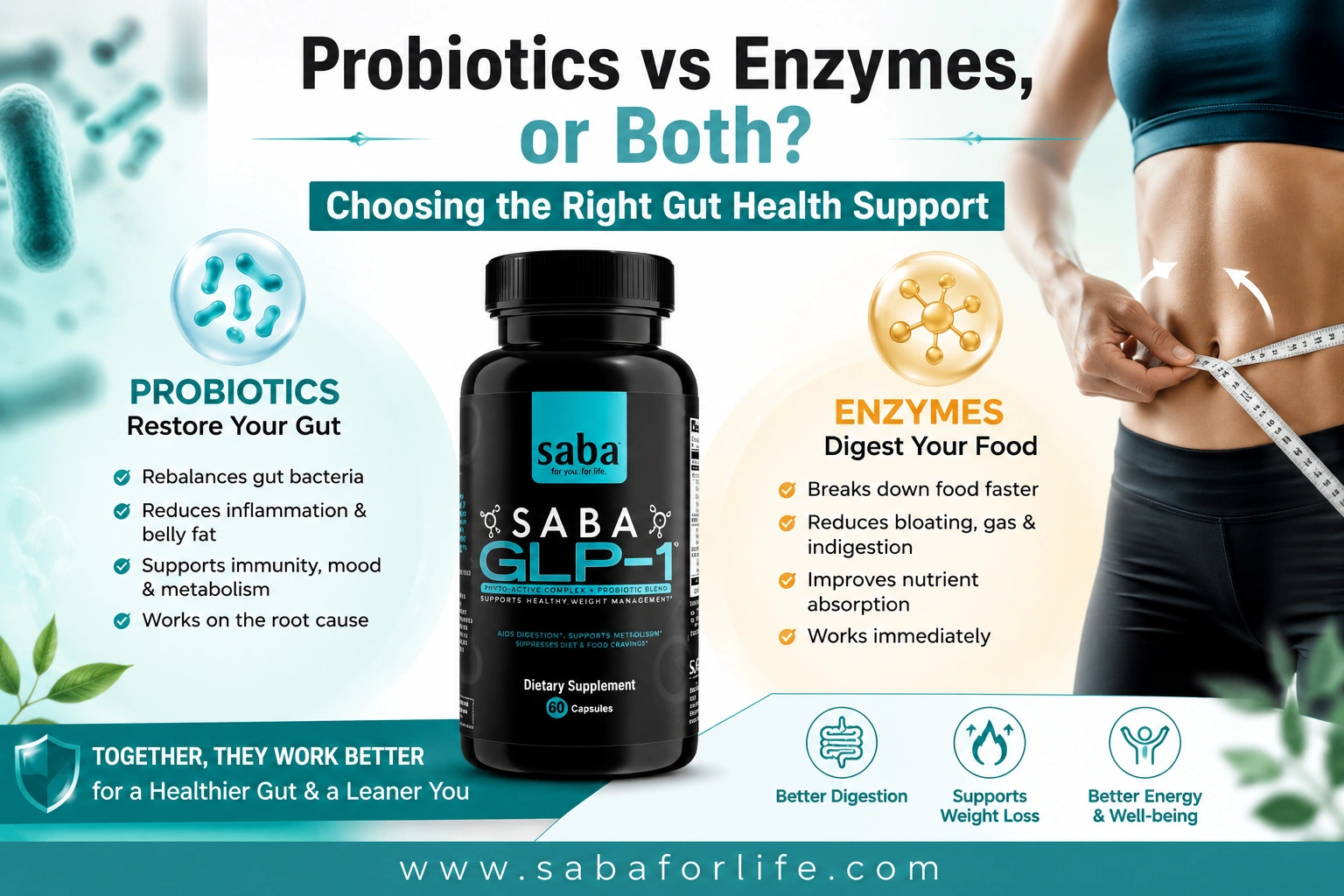
Probiotics vs Enzymes, or Both? Choosing the Right Gut Health Support
You’re eating clean. You’re drinking water. You’re even skipping late-night snacks. But your belly is still bloated, your jeans still feel tight, and the scale hasn’t budged in weeks.
Here’s the frustrating truth — the problem might not be what you’re eating. It might be what your gut is doing (or not doing) with it.
Two supplements keep coming up as the answer: probiotics and digestive enzymes. But which one is actually right for your belly fat problem? Let’s break it down clearly.
The Real Reason Belly Fat Won’t Budge (It Starts in Your Gut)
Most people blame calories. But research shows that gut health plays a massive role in how your body stores fat, manages inflammation, and controls hunger hormones.
When your gut bacteria are out of balance — a condition called dysbiosis — your body-
- Stores more fat, especially around the belly
- Produces more inflammation, which blocks weight loss
- Sends false hunger signals even after eating
- Absorbs more calories from the same food
When your digestive enzymes are low, your body-
- Can’t fully break down proteins, carbs, or fats
- Ferments undigested food — causing gas, bloating, and discomfort
- Misses out on key nutrients that regulate metabolism
What Is a Probiotic — And What Does It Actually Do?
A probiotic is live beneficial bacteria. When you take a probiotic supplement, you’re replenishing the good bacteria your gut needs to function properly.
Probiotics Help With Belly Fat By-
- Reducing gut inflammation — a hidden cause of belly fat
- Balancing the bacteria that control fat storage (especially Lactobacillus and Bifidobacterium strains)
- Improving leptin sensitivity — your body’s “I’m full” signal
- Strengthening the gut lining to prevent toxins from leaking into the bloodstream
Bottom line: Probiotics work on the ROOT CAUSE of gut-driven belly fat. They take 2–4 weeks to show results, but they fix the system.
What Is a Digestive Enzyme — And What Does It Actually Do?
Digestive enzymes are proteins your body produces to break down food. As you age — especially after 35 — enzyme production naturally drops. Stress also depletes them fast.
Digestive Enzymes Help With Belly Fat By-
- Breaking down food faster so it doesn’t sit and ferment in your gut
- Reducing the gas and bloating that make your belly look bigger
- Improving nutrient absorption — so your metabolism gets the fuel it needs
- Reducing the “heavy” feeling after meals that makes you slow and sluggish
Bottom line: Digestive enzymes work IMMEDIATELY. They help with the discomfort and bloating you feel after eating, but they don’t address the deeper gut bacteria imbalance.
Probiotic vs Digestive Enzyme — Side-by-Side Comparison
| Probiotic | Digestive Enzyme | |
| Purpose | Restores good gut bacteria | Breaks down food into nutrients |
| Best For | Bloating, gas, immunity, mood | Indigestion, food intolerance, heavy meals |
| Belly Fat Help | Yes — reduces inflammation | Indirectly — improves nutrient absorption |
| Time to Work | 2–4 weeks | Works with first dose |
| Who Needs It | Most people (gut dysbiosis is common) | People with enzyme deficiency or aging gut |
| Take With | Empty stomach or with meals | Always WITH meals |
| Side Effects | Mild bloating first few days | Nausea if taken without food |
| Bottom Line | Long-term gut health fix | Short-term digestion support |
Which One Should You Take?
Take a Probiotic If You Have- Factor
- Stubborn belly fat that won’t respond to diet
- Frequent bloating, gas, or irregularity
- Brain fog, low energy, or mood swings (gut-brain connection)
- A history of antibiotics (which wipe out good bacteria)
- Sugar cravings you can’t control
Take a Digestive Enzyme If You Have:
- Bloating immediately after eating — especially heavy or fatty meals
- Undigested food in stool (yes, this matters)
- Food intolerances like lactose or gluten sensitivity
- You’re over 40 and your digestion feels “slower” than it used to
The Smartest Move? Take Both.
Probiotics restore the gut ecosystem. Digestive enzymes fix how food is broken down in the moment. Together, they create a complete gut health system that supports fat loss from two different angles.
This is exactly why Saba GLP-1 combines a probiotic blend with a phyto-active complex — because gut health isn’t a one-supplement problem.
Probiotics, Enzymes, or Both?
If your belly fat feels more like “stuck inflammation” than just extra calories, your gut is the place to start — not another diet.
Start with a quality probiotic to fix the root cause. Add digestive enzymes if you regularly feel bloated or heavy after meals. And if you want a supplement that supports both gut health and natural weight loss together, Saba GLP-1 is worth exploring.